
Why Branded Desk Accessories Earn the Most Impressions
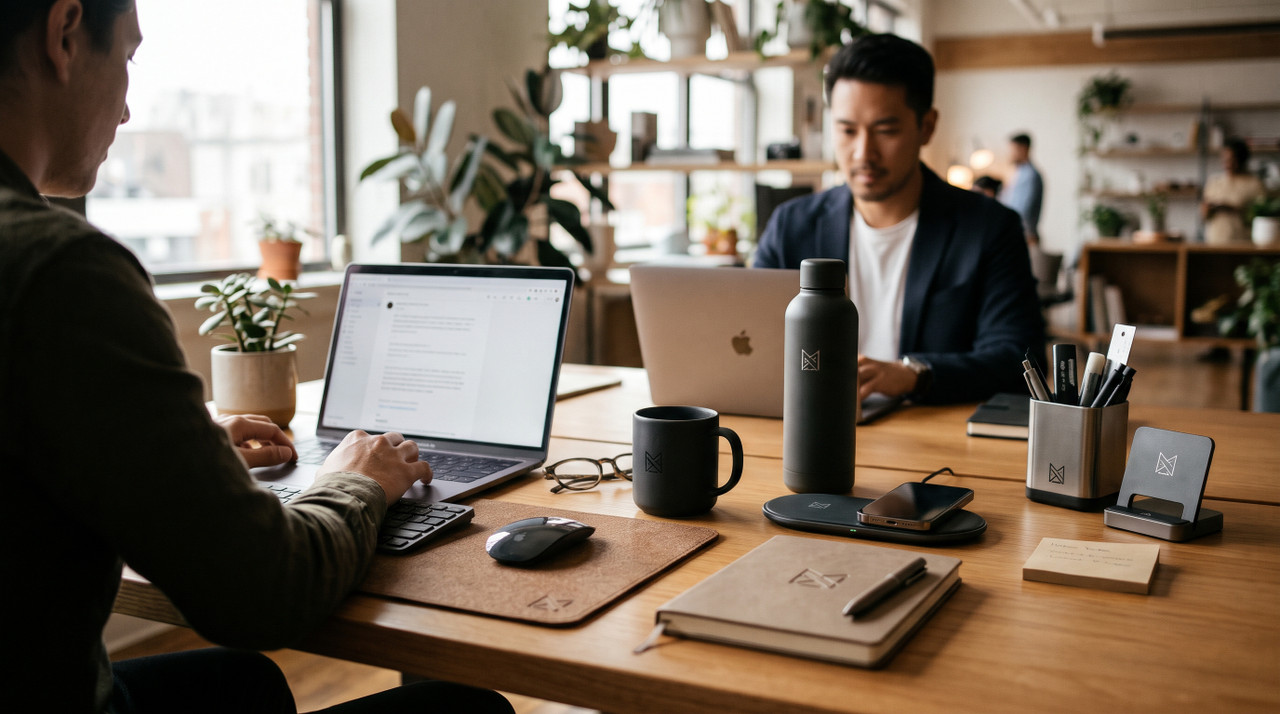
Most promotional merchandise only generates an impression when someone actively uses it — wearing a cap, carrying a bag, drinking from a bottle. Desk accessories work differently. A branded organiser, phone stand or document tray sits in frame on every video call and every desk walk-by without the recipient doing anything at all. That passive visibility is what makes desk accessories one of the most efficient categories in a merchandise program, not just a "nice to include" line in an onboarding kit.
Why do desk accessories generate impressions without any action from the recipient?
Every other merchandise category needs the recipient to do something — wear it, carry it, drink from it — before it generates a brand impression. A desk accessory is visible the moment it's placed on a desk, and it stays visible for as long as it's there: during every video call, every in-person meeting at that desk, every time a colleague walks past.
That's a fundamentally different economics profile to apparel or drinkware, where impressions are tied to frequency of active use. A desk accessory's impressions are tied to time in place instead — which for a genuinely useful item is measured in years, not uses per week.
Why did hybrid work turn desk accessories into a genuine merchandise category?
PwC research puts the share of Australian knowledge-based workers who are hybrid or fully remote at 96%, which means most employees are now maintaining two desks — one at the office, one at home — each visible on camera during video calls in a way an office desk never was before hybrid work became standard.
Source: PwC
That visibility changes what a desk accessory does for a business. A branded item on a home desk isn't just functional for the employee — it's in the background of every client call, every team meeting, every screen share, for as long as it stays on the desk.
What desk accessories are Australian businesses actually ordering?
Demand has shifted toward accessories that solve a genuine desk-clutter problem rather than decorative add-ons:
- Desk organisers — for pens, cables, sticky notes and general clutter
- Phone and tablet stands — genuinely useful during video calls specifically
- Document trays — practical for anyone managing physical paperwork alongside a hybrid setup
- Mouse mats — low-cost, near-universal utility
- Pen holders and multi-function caddies — small, but permanently visible
The common thread is permanence. Unlike a notebook that fills up or a tote that wears out, a well-made desk organiser or stand stays exactly where it's placed, often for years.
Browse Brandconnect's office and business range to compare desk accessories by material and function.
What makes a desk accessory look premium instead of promotional?
Desk items sit in a small, permanent, highly visible space — which means design quality matters more here than almost any other merchandise category, because a cheap-looking item is on display every single day rather than tucked away.
Details that separate a desk accessory people display from one they hide in a drawer:
- Natural materials — wood, bamboo or woven textures read as considered rather than corporate
- Minimalist form — clean lines and neutral colours (black, white, natural wood) suit almost any desk setup
- Genuine functionality — an organiser that actually fits the clutter it's meant to solve, not a generic slot arrangement
- Restrained branding — a small engraved or embossed mark rather than a printed logo across the visible surface
A desk accessory someone is proud to keep visible does more brand work than one they quietly move to a drawer the day it arrives.
Which desk accessory suits which use case?
|
Accessory |
Best suited to |
Why it works |
|
Desk organiser |
General onboarding kits, hybrid home setups |
Solves visible clutter, stays in place for years |
|
Phone/tablet stand |
Anyone on frequent video calls |
Directly useful during the exact moment of highest visibility |
|
Document tray |
Roles with ongoing paperwork |
Practical utility beyond the video-call use case |
|
Mouse mat |
Low-cost bulk desk kits |
Near-universal utility at minimal cost per unit |
Frequently Asked Questions
Why are desk accessories considered high-value promotional merchandise?
Unlike apparel or drinkware, desk accessories generate impressions passively — they're visible on every video call and desk walk-by without requiring the recipient to actively use them, and a well-made item stays in place for years.
What desk accessories work best for a hybrid work onboarding kit?
A desk organiser and a phone or tablet stand are the strongest combination — both solve a genuine setup problem for a new hybrid employee and remain visible during video calls specifically.
Does branding placement matter on desk accessories?
Yes, more than on most categories. A desk item is on permanent display, so a small engraved or embossed mark reads as premium, while a large printed logo reads as promotional clutter someone is more likely to remove from view.
Why did hybrid work increase demand for desk accessories specifically?
With 96% of Australian knowledge workers now hybrid or remote, most employees maintain a functional desk at home as well as the office — and that home desk is now visible on camera during video calls in a way it never was before.
What material makes a desk accessory look premium rather than promotional?
Natural materials like wood or bamboo, and a minimalist neutral design, read as considered rather than corporate — the same principle that applies to premium apparel and drinkware.
Key Takeaways
- Desk accessories generate brand impressions passively — visible on every video call and desk walk-by without requiring the recipient to actively use the item.
- 96% of Australian knowledge workers are hybrid or fully remote, meaning most employees now maintain a second, camera-visible desk at home.
- Desk organisers and phone/tablet stands are the strongest fit for onboarding kits, solving a genuine setup problem rather than adding decorative clutter.
- Natural materials and minimalist design separate a desk accessory people display from one they move to a drawer.
- Restrained, engraved or embossed branding outperforms printed logos on desk items specifically, because the item is on permanent visible display.
Build a Desk Accessory Program That Stays Visible
The businesses getting the most from desk accessories aren't choosing the cheapest organiser available — they're choosing materials and designs people are happy to keep in view, on a desk that's now visible on camera as often as it's used in person.
Browse Brandconnect's office and business range to compare desk accessories, or use our AI Merch Search to match products to your onboarding or hybrid-work program. Call 1300 567 565 or visit Brandconnect to get started.
Brandconnect blog: Insights, trends & merch tips

Why Branded Desk Accessories Earn the Most Impressions
Most promotional merchandise only generates an impression when someone actively uses it — wearing a...
How Branded Tote Bags Became a Daily Essential
A branded tote bag used to mean a thin plastic-weave freebie handed out at a trade show. Today it's...
Custom Branded Apparel People Actually Wear
Most branded apparel doesn't fail because of the logo. It fails because of the garment underneath it...

Avoidable Mistakes When Ordering Promotional Merchandise
Most wasted promotional merchandise budget doesn't come from a bad product category. It comes from a...
Why Branded Drink Bottles Beat Digital Ads on ROI
AI-generated content now fills most of what people scroll past in a day ; ads, emails, social posts,...

How Major Events Shape Promotional Product Trends in Australia
Australia is entering the busiest decade of major events in its history. The Men's Rugby World Cup a...